
LIMA - 18 HOLES - FREE

LIMA
CITY MAP MINIGOLF

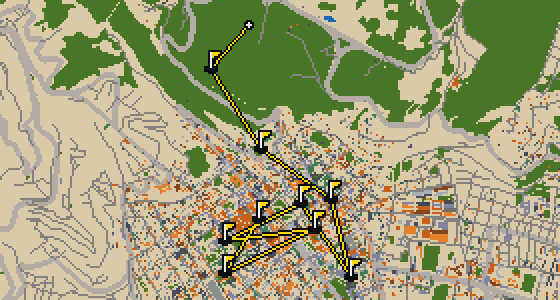
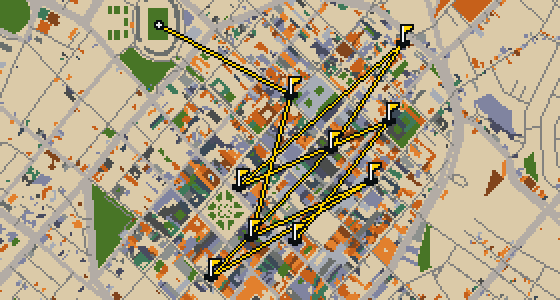
Lima - 18 stops - par 53

The ball finds the cup at the Catedral de Lima to finish a full round of 18 holes. This course uses the real streets of Lima as the map, with the city's actual attractions forming the obstacles and holes. A local guide like Skip knows these corners well, including where to find the best crumbs. The walk covers 11 km and uses 10 portals to move between districts, with a total par of 53.

Trouble loading? Open the game in its own tab.

HOW IT WORKS

01

Pick a city

The course is drawn on the real street grid, so the map you play is the map you walk.

02

Putt to the pin

Drag to aim, release to swing. Buildings bounce and water costs you a stroke.

03

Sightsee between strokes

Every hole ends at an attraction. Sink the putt, read the story, walk to the next tee.

THE LIMA ROUND - STOP BY STOP

HOLE 1 - PAR 3

Catedral de Lima

The Catedral de Lima is a Renaissance cathedral and a cultural heritage of Peru. Construction began in 1535 by Francisco Pizarro, and Francisco Becerra served as the architect for the site. The building was constructed in its present form between 1602 and 1797. This Roman Catholic cathedral in Lima, Peru, serves as the seat of the Archdiocese of Lima. You can see the influence of the Renaissance style in the architecture, which remains a central point of the city's religious and cultural identity.


Wikidata · Wikipedia

HOLE 2 - PAR 3

Arco del Barrio Chino

The Arco del Barrio Chino is an 8-meter-tall paifang located at the entrance of Lima's Chinatown in Barrios Altos. Construction on the arch started in 1971. The monument was donated to Peru by the Chinese colony and the Government of the Republic of China (Taiwan) to commemorate Peru's 150th year of independence. You can pick out the intricate details of the portal as you enter the neighborhood. I've noticed the colors here always look sharp against the city streets, making it a great spot to pause for a moment before you keep moving.

Wikidata · Wikipedia

HOLE 4 - PAR 2

Casa de Osambela

I can show you to the historic center of Lima, where you will find Casa de Osambela. This building is recognized as cultural heritage of Peru. It stands on the site of the old novitiate of the Dominican fathers, which was destroyed by the earthquake of 1746. You can pick out the Neoclassicism style used in its design. It is a fine example of the architecture found in the city's heart. I've always found the surrounding streets to be a great place for a stroll.

Wikidata · Wikipedia

HOLE 5 - PAR 3

Casa O'Higgins

Casa O'Higgins is a building in the historic centre of Lima, situated specifically on the Jirón de la Unión. This colonial-style structure is part of the cultural heritage of Peru and serves as a permanent space dedicated to the memory of Bernardo O'Higgins. Since 2008, the house has functioned as a cultural centre of the Pontifical Catholic University of Peru. I find the architecture here quite striking compared to the newer blocks nearby, and it is a great spot to pause and look at the surroundings before moving on to the next street.

Wikidata · Wikipedia

HOLE 6 - PAR 3

Museo Electoral y de la Democracia

The National Jury of Elections maintains its headquarters next to Nicolás de Piérola Avenue in the historic centre of Lima. Inside this building, you can find the Museo Electoral y de la Democracia. This museum focuses on the electoral history of Peru, with a mission to investigate, preserve, and disseminate heritage from the 19th and 20th centuries. It is a great spot to see how the country's voting traditions evolved over two centuries. I've noticed the building has a very formal air to it.

Wikidata · Wikipedia

HOLE 7 - PAR 3

Museo de Arte Italiano

The Museo de Arte Italiano is an art museum that forms part of the cultural heritage of Peru. It is a public museum in Lima and holds a unique position as the only European arts museum in the city. Founded in 1923, the institution is managed by the Peruvian Ministry of Culture. I've noticed that the building's presence adds a distinct touch to the neighborhood's character. Whether you are an art lover or just passing through, this spot is a great place to pause and appreciate the local curation of European works.

Wikidata · Wikipedia

HOLE 8 - PAR 3

Torre del Reloj Alemana

You can find the Torre del Reloj Alemana in the historic centre of Lima, Peru. It sits in the University Park at the intersection of Abancay and Nicolás de Piérola avenues, directly in front of the Casona de la Universidad Nacional Mayor de San Marcos. Also known as the German Tower or the University Clock, the tower was donated in 1921 by the German community in Lima to mark the Centennial of the Independence of Peru. I've noticed that the intersection here is always buzzing with energy, making it a great spot to watch the city move while you admire the clock.

Wikidata · Wikipedia

HOLE 9 - PAR 3

Plaza San Martín

You will first notice the central monument giving homage to José de San Martín. This square was designed by architect Manuel Piqueras Cotolí and is recognized as cultural heritage of Peru. It sits near the Plaza Mayor, and the two are connected by the Jiron de la Union. The square is located at the ninth block of Colmena avenue within the Historic Centre of Lima, which UNESCO declared a World Heritage Site in 1988. I usually find the walk between the two plazas to be one of the best ways to see the city.

Wikidata · Wikipedia

HOLE 10 - PAR 3

Iglesia y Convento San Agustín

The Iglesia y Convento San Agustín is a church building designed in the Baroque style. It is a Catholic temple and is recognized as cultural heritage of Peru. You can find this site in the city of Lima, situated specifically at the junction of the fourth block of Jirón Camaná with the second block of Jirón Ica. This location is significant because it forms part of the historic centre of Lima. It is a place for reflection and a testament to the city's architectural history.

Wikidata · Wikipedia

HOLE 11 - PAR 2

Palacio de Gobierno

Look at the baroque revival style of the Palacio de Gobierno before you take in the whole site. This palace occupies the northern side of the Plaza Mayor in Lima and is known as the House of Pizarro. It is a piece of the cultural heritage of Peru, designed by architects Claude Sahut and Ricardo de Jaxa Malachowski. It is the official residence of the president of Peru and the seat of the executive branch of the Peruvian government. I've seen many tourists stop here to admire the facade.

Wikidata · Wikipedia

HOLE 12 - PAR 3

Museo de Sitio Parque de La Muralla

The Museo de Sitio Parque de La Muralla is a park located between the Rímac River and the historic centre of Lima. It is a public space where you can find part of the former Walls of Lima within the park's extension. The site sits in the central district of Lima, Peru, and was inaugurated in 2004. I think it is a great spot to stretch your legs while seeing a piece of the city's old defenses. Let me show you where these old stones meet the modern streets of the central district.

Wikidata · Wikipedia

HOLE 13 - PAR 3

Basílica de San Pedro

The Basílica de San Pedro is a church building designed in the Neoclassical architecture style. Located in the historic centre of Lima, Peru, it is a Jesuit church that holds the status of a cultural heritage of Peru. This site is also recognized as a World Heritage Site. The building, which was started in 1638, was formerly known as the Basilica of Saint Paul. It remains an important Catholic church within the city, providing a glimpse into the religious and architectural history of the region for those visiting the area.

Wikidata · Wikipedia

HOLE 14 - PAR 3

Plaza Italia

You can pick out the open layout of Plaza Italia, a square located in the Barrios Altos neighbourhood of Lima. This site is cultural heritage of Peru and was formerly known as Saint Anne's Square. It holds a significant place in the city's history as one of the four squares where the independence of Peru was declared. I've noticed it's a great spot to pause and imagine the colonial era, as it was the second square built by the Spanish during that period.

Wikidata · Wikipedia

HOLE 15 - PAR 4

Quinta Heeren

Let me show you Quinta Heeren, a traditional residential estate located within the historic centre of Lima. Óscar Heeren, a German–Peruvian merchant, commissioned and oversaw the construction of this architectural ensemble during the late 19th century. It occupies a total area of about 36.000 m2 in the Barrios Altos neighbourhood. While it started as a private residence, it is now part of the cultural heritage of Peru. You can pick out the scale of the grounds as you roll through; it is a massive space for a city center.

Wikidata · Wikipedia

HOLE 16 - PAR 3

Plaza Bolívar

Let me show you Plaza Bolívar, a square located at the second block of Abancay Avenue in the Barrios Altos neighbourhood. It is cultural heritage of Peru and sits three blocks east of the main square of Lima. You can pick out the Legislative Palace, which is the seat of the Congress of Peru. I also suggest visiting the Former Tribunal of the Inquisition; it is a museum that once housed both the senate and the tribunal. It's a great spot to stretch your legs since it forms part of the historic centre of Lima.

Wikidata · Wikipedia

HOLE 17 - PAR 3

Plaza de Toros de Acho

Let me show you the Plaza de Toros de Acho. This bullring is located in Lima, Peru, beside the historical center of the Rímac District. It opened on 30 January 1766 and is recognized as cultural heritage of Peru. You can pick out its importance as a national historic monument, making it a significant stop for anyone visiting the city. I usually find the area quite lively, though I prefer to keep my distance from the actual events. It is a first class bullring that stands as a major landmark of the region.

Wikidata · Wikipedia

HOLE 18 - PAR 3

Alameda de los Descalzos

In the Rímac District of Lima, you will find the Alameda de los Descalzos. This park is recognized as cultural heritage of Peru and stretches for about 450 m. As you walk through, you can pick out the churches of Santa Liberata, El Patrocinio, and Nuestra Señora de los Ángeles standing around the park. Micaela Villegas's Mill House was also located nearby. I have found that it is a great spot to watch the city move while you take a breather and enjoy the surroundings. It is a peaceful stretch of greenery in the heart of the city.

Wikidata · Wikipedia

STOP 19

Quinta de Presa

Let me show you the Quinta de Presa, which was built during the government of the viceroy of Peru, Manuel de Amat y Junyent. This French-style country mansion from the 18th century is located in the jirón Chira of the Rímac district. You can pick out the Rococo style in the design of this estate, which comprises a constructed area of 15,159 square metres. It is considered cultural heritage of Peru and is part of a UNESCO World Heritage Site. I've noticed the scale of the place is quite something.

Wikidata · Wikipedia

OTHER COURSES

9 HOLES - PAR 27

Arequipa

9 stops

This is Arequipa. The map is the real city and the round is played on its real streets, where attractions like the Monasterio de Santa Catalina are the holes. Skip is a local guide who knows the place. This quick round of 9 holes is a 5.3 km walk with a par of 27, using 10 portals to move between districts.

9 HOLES - PAR 25

Cusco

9 stops

Cusco is the setting for this round, played on the actual streets of the city. The map follows the real layout, where attractions like Sacsayhuamán become the holes. A quick 9-hole round with a par of 25 covers a walk of 4.5 km. Skip knows every cobblestone and crumb of bread in this place and acts as the local guide.

9 HOLES - PAR 27

Trujillo

9 stops

This is a quick nine-hole round through Trujillo. The map follows the real city, with the ball rolling across actual streets and banking off building facades. Real attractions like the Palacio Iturregui are the holes, and two portals help bridge the distance. Skip knows these corners well and will be the local guide for the 4.9 km walk.

FAQ

Is it free to play?

Yes. Every course runs in the browser with no account and no install.

Do I need to be in the city?

No. The full round plays from anywhere. Walking the real route is a nice way to see the city, but it is not required.

Are the maps real?

Yes. The geometry comes from OpenStreetMap data, rendered chunky on purpose. Streets, water and parks sit where they really are.