
TRIESTE - 18 HOLES - FREE

TRIESTE
CITY MAP MINIGOLF

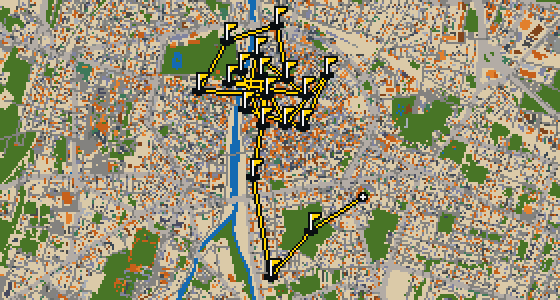
Trieste - 18 stops - par 57

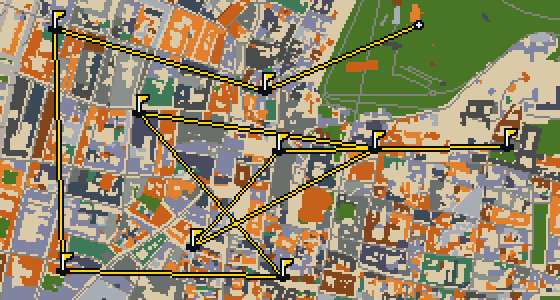
From a perch on the rooftops, Trieste looks like a giant game board of white stone and blue water. This map is the real city, and the round is played on its actual streets. Real attractions, including the Cattedrale di San Giusto, are what the holes are built from. As a local guide, Skip knows every alley. This full round of 18 holes is a 12.1 km walk with a par of 57, using 16 portals to bridge the gaps between the landmarks.

Trouble loading? Open the game in its own tab.

HOW IT WORKS

01

Pick a city

The course is drawn on the real street grid, so the map you play is the map you walk.

02

Putt to the pin

Drag to aim, release to swing. Buildings bounce and water costs you a stroke.

03

Sightsee between strokes

Every hole ends at an attraction. Sink the putt, read the story, walk to the next tee.

THE TRIESTE ROUND - STOP BY STOP

HOLE 1 - PAR 3

Cattedrale di San Giusto

You will first notice the Romanesque architecture style of Cattedrale di San Giusto. This Roman Catholic cathedral is located in Trieste, in northeastern Italy, and is dedicated to Saint Justus. It is the seat of the Bishop of Trieste and also functions as a minor basilica and a parish church. For those interested in the history of the site, the building is also a religious museum. The cathedral is a significant local landmark that welcomes 10,000 annual visitors to its doors.


Wikidata · Wikipedia

HOLE 2 - PAR 3

Museo Revoltella - Galleria d'arte moderna

Let me show you the Museo Revoltella - Galleria d'arte moderna. This art museum was founded in 1872 and was designed by the architect Friedrich Hitzig. Since its opening, it has become a site of Italian national heritage. You can pick out various collections within this historic house museum, which continues to attract 23,457 annual visitors. I've noticed it's a great spot to spend an afternoon away from the bustle of the streets, allowing you to appreciate the art and the building itself in a more relaxed environment.

Wikidata · Wikipedia

HOLE 3 - PAR 3

Molo Audace

Let me show you Molo Audace, a pier located in the centre of Trieste. It sits on the shores of the city, positioned a few steps from the Grand Canal and Piazza Unità d'Italia. This spot is a key part of the waterfront because it separates the San Giorgio basin from the San Giusto basin of the Old Port. I've found it's a great place to get your bearings and enjoy the sea air before heading back into the bustle of the city. It is a wonderful spot for any visitor to take a moment and look out over the water.

Wikidata · Wikipedia

HOLE 4 - PAR 3

Teatro Romano

You might expect a contemporary playhouse, but the Teatro Romano is actually an archaeological site and a Roman theatre. It is a Museum of the Italian Ministry of Culture and is recognized as Italian national heritage. You can walk through the remains of the ancient structure or visit the museum to see various archaeological artifacts. I find the contrast between these ancient stones and the surrounding city quite striking, though I usually stick to the higher ledges to get a better view of the layout.

Wikidata

HOLE 5 - PAR 3

Museo postale e telegrafico della Mitteleuropa

Let me show you the Museo postale e telegrafico della Mitteleuropa. Founded in 1997, this specialized museum is a private collection that has been officially recognized as Italian national heritage. It is a quiet spot in the city, seeing about 300 annual visitors. You can pick out the specific focus of the exhibits as you walk through the galleries. I find it a relaxing place to avoid the busier crowds, and it is a great way to see a different side of the local culture. It is the kind of place where you can really take your time with the displays.

Wikidata

HOLE 6 - PAR 3

Museo della comunità Ebraica di Trieste Carlo e Vera Wagner

You will find the Museo della comunità Ebraica di Trieste Carlo e Vera Wagner at via del Monte 5/7. This Jewish museum is a private institution and is recognized as Italian national heritage. It was inaugurated in 1993 and functions as a religious and history museum for the city. I have noticed it remains quite an intimate spot for those who visit, with 673 annual visitors coming through its doors to explore the exhibits. It is a focused space that provides a specific window into the local community's past without the crowds of the larger galleries.

Wikidata · Wikipedia

HOLE 7 - PAR 3

Museo teatrale Carlo Schmidl

Wikidata

HOLE 8 - PAR 3

Rifugio antiaereo Kleine Berlin

You might expect a museum to be a grand building with high ceilings, but Rifugio antiaereo Kleine Berlin is different. This military museum is actually a complex of underground air-raid tunnels dating to World War II. Located in Trieste, Italy, the site is recognized as Italian national heritage. I've found that the subterranean atmosphere makes the history feel much more immediate than a standard exhibit. It operates as a private museum, welcoming 721 annual visitors who come to see these hidden corridors.

Wikidata · Wikipedia

HOLE 9 - PAR 3

Sinagoga di Trieste

Located at Via S. Francesco D'Assisi 19 in Northern Italy, this site is an Orthodox Jewish congregation and synagogue. The inception of the Sinagoga di Trieste was in 1908. Ruggero Berlam was an architect of the building, and the structure is noted for its Orientalism style. This place of worship serves the Jewish community of Trieste in the Friuli-Venezia Giulia region. The building was designed by Ruggero Berlam and Arduino Berlam in the Romanesque Revival style and was completed in 1912.

Wikidata · Wikipedia

HOLE 10 - PAR 3

Tempio serbo-ortodosso della Santissima Trinità e di San Spiridione

The inception of Tempio serbo-ortodosso della Santissima Trinità e di San Spiridione was in 1868. Located in Trieste, Italy, this church building was designed by architect Carlo Maciachini and is built in the Byzantine Revival architecture style. It is an Eastern Orthodox church that remains under the jurisdiction of the Serbian Orthodox Eparchy of Switzerland of the Serbian Orthodox Church. You can observe the distinct features of its Byzantine Revival style as you approach the entrance of this historical site.

Wikidata · Wikipedia

HOLE 11 - PAR 4

Basilica di San Silvestro

The Basilica di San Silvestro is a Protestant church building. It is constructed in the Romanesque architecture style. This building is a point of interest for visitors exploring the religious history of the city. When you look at the facade and the layout, you can see the characteristics of the Romanesque architecture style. It remains a place of worship and a historical landmark within the urban environment of Trieste.

Wikidata

HOLE 12 - PAR 2

Lanterna

Let me show you Lanterna. This lighthouse was started in 1833 to guide ships into the harbor, ensuring they navigate the coast safely. You can pick out the tower easily from a distance because it reaches a height of 31 meters. It is a vital landmark for anyone navigating the waters around Trieste. I have spent many afternoons watching the ships keep a close eye on this light as they come into port, and it is always a sight to see them align with the tower's glow.

Wikidata

HOLE 13 - PAR 4

Museo ferroviario (closed)

Let me show you the Museo ferroviario. This railway museum is housed in the Trieste Campo Marzio railway station and is concerned with railway and tram transportation. Established in 1984, the site is recognized as Italian national heritage. You can pick out the scale of the old station, though the museum has been closed for renovation by the Fondazione FS since July 2017. I usually find the quiet of these old tracks quite peaceful, and it is a great spot to see how the city handled its heavy machinery in the past.

Wikidata · Wikipedia

HOLE 14 - PAR 3

Chiesa di Cristo

Notice the Neoclassicism style of the architecture before looking at the building as a whole. Chiesa di Cristo is a church building that dates back to its inception in 1830. This place of worship is a piece of the city's architectural history, characterized by the symmetry and order typical of its design style. Visitors can observe how these classical elements define the structure and its presence within the neighborhood. It is a site where the city's religious heritage and its commitment to classical aesthetics meet in a single, enduring building.

Wikidata

HOLE 15 - PAR 3

Teatro Lirico Giuseppe Verdi

You might think this is just another city theater, but it is the Teatro Lirico Giuseppe Verdi, a historic opera house in Trieste, Italy. It started its life as the Teatro Nuovo, opening its doors on 21 April 1801. While the previous venue, the Cesareo Regio Teatro di San Pietro, held 800 people, this new space initially offered 1,400 seats. By 1821, the building became known as the Teatro Grande. It was designed by the architect Gian Antonio Selva. I've found that the acoustics here are a real treat for anyone who enjoys a powerful soprano.

Wikidata · Wikipedia

HOLE 16 - PAR 4

Imperatrice Elisabetta d'Austria

Imperatrice Elisabetta d'Austria is a memorial located in the city of Trieste. This site is dedicated to remembrance and serves as a place for visitors to reflect in a calm environment. Regarding its history, this particular memorial had its inception in 1912. It is an important part of the local landscape for those interested in the memorials of the city.

Wikidata

HOLE 17 - PAR 3

Politeama Rossetti

Look at the facade of the Politeama Rossetti before heading inside this theatre building in Trieste. It is a busy spot for the arts, with a season that runs from October to June. You can pick out a wide variety of stage shows throughout the year, including plays, musicals, dance, and ballet. They even host rock concerts. With over 60 shows scheduled each season, there is almost always something happening on the stage. I've noticed it's a great place to spend an evening if you enjoy a crowded lobby and a big performance.

Wikidata · Wikipedia

HOLE 18 - PAR 4

Civico Orto Botanico

You will first notice the diverse plant collections at the Civico Orto Botanico. This municipal botanical garden is a place where nature and science meet, and it also functions as a museum. Because it is designated as Italian national heritage, it is a significant stop for anyone visiting the city. I find it a great spot to stretch your legs and enjoy some greenery away from the urban bustle. If you are looking for the entrance, the garden is located at via Marchesetti 2 in Trieste, Friuli-Venezia Giulia.

Wikidata · Wikipedia

STOP 19

Slovensko stalno gledališče / Teatro Stabile Sloveno

The building was designed in the 1960s by Edo Mihevc, a Slovene architect of Trieste descent. It houses the Slovensko stalno gledališče, a theatre company that was founded in 1902. Located right here in Trieste, the Slovene Civic Theatre is the professional theatre of the Slovene minority in the city. I always find the architecture here quite striking compared to the older stones of the center, and it is a great place to see how the local culture is preserved through the performing arts.

Wikidata · Wikipedia

OTHER COURSES

9 HOLES - PAR 26

Reggio Emilia

9 stops

Reggio nell'Emilia is the setting for this round, where the map is the actual city and the ball rolls along its real streets. The holes are built from local attractions, including the Cattedrale di Santa Maria Assunta. Skip knows these blocks well. This quick 9-hole round covers a 5 km walk with a total par of 26.

9 HOLES - PAR 26

Modena

9 stops

From a rooftop perch, Modena looks like a clean slate for a quick nine-hole round. The map is the real city and the ball rolls across its actual streets, using attractions like the Duomo di Modena as the holes. Two portals help skip the long stretches of a 4.8 km walk. Skip knows these alleys well and will be the local guide.

18 HOLES - PAR 55

Parma

18 stops

This is Parma, where the map is the real city and the round is played on its actual streets. The holes are built from real attractions, ending the walk at the Torrione Visconteo. Skip is a local guide who knows the place and where the best crumbs are hidden. A full round of 18 holes takes a 10.5 km walk with a par of 55, using four portals to bridge the gaps.

9 HOLES - PAR 26

Brescia

9 stops

Brescia is the setting for this round, with the ball rolling across the real streets of the city. The holes are built from actual attractions, including the Castello di Brescia. This quick 9-hole round covers 4.9 km and uses 16 portals to move between districts. Skip knows these pavements well and is the local guide.

9 HOLES - PAR 27

Reggio Calabria

9 stops

Reggio di Calabria is the setting for this round, where the map follows the real city and the ball rolls across its actual streets. Real attractions like the Castello Aragonese provide the architecture for the holes. This is a quick nine-hole round covering a 5.6 km walk. I know these sidewalks well and will act as the local guide.

FAQ

Is it free to play?

Yes. Every course runs in the browser with no account and no install.

Do I need to be in the city?

No. The full round plays from anywhere. Walking the real route is a nice way to see the city, but it is not required.

Are the maps real?

Yes. The geometry comes from OpenStreetMap data, rendered chunky on purpose. Streets, water and parks sit where they really are.