
MONTEVIDEO - 9 HOLES - FREE

MONTEVIDEO
CITY MAP MINIGOLF

Montevideo - 9 stops - par 27

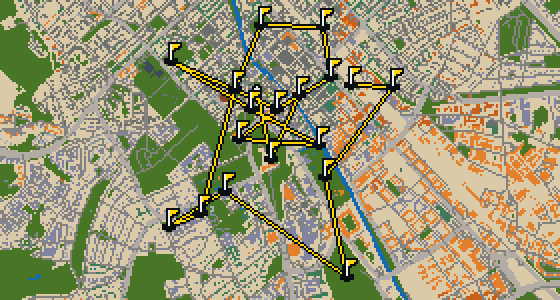
From a bird's eye view, Montevideo unfolds as a grid of wide avenues and coastal breezes. The map is the real city and the round is played on its real streets, with landmarks like the Palacio Legislativo as the holes. A quick 9-hole round covers 6 km and uses 2 portals to skip across town. Skip knows these sidewalks well enough to guide the ball through every bank and roll.

Trouble loading? Open the game in its own tab.

HOW IT WORKS

01

Pick a city

The course is drawn on the real street grid, so the map you play is the map you walk.

02

Putt to the pin

Drag to aim, release to swing. Buildings bounce and water costs you a stroke.

03

Sightsee between strokes

Every hole ends at an attraction. Sink the putt, read the story, walk to the next tee.

THE MONTEVIDEO ROUND - STOP BY STOP

HOLE 1 - PAR 3

Palacio Legislativo

Let me show you the Palacio Legislativo. Built in the Neoclassicism style by architects Vittorio Meano and Giannino Castiglioni, this building is a Cultural Heritage Monument. You can find it located in the Aguada neighborhood of Montevideo. Beyond its appearance, the palace is the seat of the legislative branch of the Uruguayan government and the meeting place of the General Assembly of Uruguay. Its inception was in 1925. I have noticed that the scale of the place makes it a great landmark for getting your bearings in the city. Whether you are interested in the architectural details or the political history of the region, this site provides a clear look at how the Uruguayan government organizes its legislative work in a setting that is recognized as a protected monument.


Wikidata · Wikipedia

HOLE 2 - PAR 3

Museo Nacional de Historia Natural

Let me show you the Museo Nacional de Historia Natural. This natural history museum opened in 1838 and holds the title of being the oldest scientific institution in Uruguay. Depending on what you are looking for, you will need to visit two different spots in Montevideo. The museum's first permanent exhibition space is located at Miguelete 1825. However, if you are interested in the research side of things, the scientific collections, library and administrative offices are housed at Calle 25 de Mayo 582 in the Old City. I have noticed that the distance between these two locations provides a nice opportunity to see a few different neighborhoods while you explore the city's scientific history. It is a great way to get your bearings in the city.

Wikidata · Wikipedia

HOLE 3 - PAR 3

Parroquia Nuestra Señora del Carmen

Parroquia Nuestra Señora del Carmen is a Roman Catholic parish church in Montevideo, Uruguay. This church building is a Cultural Heritage Monument and a cultural property. When you look at the exterior, you can see that it was built in the Neoclassical architecture style. Construction on the site was started in 1891. Many people in the city know this place by its popular name, Iglesia de la Aguada. It stands as a significant religious site within the community, maintaining the architectural standards of its era. Whether you are visiting for the history or the architecture, the structure provides a clear example of the Neoclassical influence in the region. The building continues to be recognized for its value as a cultural property in the city of Montevideo.

Wikidata · Wikipedia

HOLE 4 - PAR 3

Plaza Isabel De Castilla

Let me show you Plaza Isabel De Castilla. This location is a square within the city. It is a spot where you can stop and get your bearings while walking through the neighborhood. I have noticed that the open space makes it a handy landmark for anyone navigating the area on foot.

Wikidata

HOLE 5 - PAR 2

Museo del Automóvil Club del Uruguay

You might expect a city's main car collection to be a state-run institution, but this is a private museum. The Museo del Automóvil Club del Uruguay is an automobile museum that has been open since it was founded in 1983. It provides a dedicated space for enthusiasts to see a curated selection of vehicles in a specialized setting. When you walk through the doors, you can see how the private nature of the collection shapes the experience. I have noticed that the passion for cars here is as strong as the passion for football in the rest of the city. It is a great spot to stop and admire the machinery if you have a few minutes to spare while exploring the streets of Montevideo.

Wikidata

HOLE 6 - PAR 3

Museo de Historia del Arte

When you arrive at the Museo de Historia del Arte, you will notice the focused atmosphere of this local museum. It is a place dedicated to preserving and displaying art for the community. I can show you around the galleries where the city's creative history is kept. This institution was founded in 1957, providing a dedicated space for artistic exploration in Montevideo. Whether you are an art enthusiast or just passing through on your way to another landmark, it is a spot that offers a glimpse into the region's aesthetic values. I usually find the quiet halls a nice break from the bustling street traffic outside, where the noise of the city fades away and the focus shifts entirely to the work on the walls.

Wikidata

HOLE 7 - PAR 3

Torre Saeta

Let me show you Torre Saeta. This structure is a television tower made of concrete and steel, designed to transmit signals across the city. It is one of the most visible landmarks in the skyline because it reaches a height of 187 meters. Whether you are looking for a point of orientation or just admiring the engineering, you can pick out its silhouette from almost anywhere in the area. I usually see a few of my friends perched on the higher ledges during a clear afternoon, watching the traffic move below. It is a sturdy piece of infrastructure that keeps the city connected to its broadcasts, ensuring that the local signals reach every home. It is a towering presence that dominates the local view, providing a helpful reference point for visitors and locals alike as they move through the urban landscape.

Wikidata

HOLE 8 - PAR 3

Museo de Historia Natural Dr. Carlos Torres de la LLosa

Let me show you the Museo de Historia Natural Dr. Carlos Torres de la LLosa. This site is a natural history museum that holds a significant place in the city. The institution was founded in 1911, making it a long-standing resource for those interested in the natural world. You can pick out various exhibits that detail the history of life and the environment. I find that the atmosphere here is a great change of pace from the busier streets outside. Whether you are a lifelong student of science or just passing through, the collections provide a window into the biological diversity of the region and beyond. It is a wonderful spot to pause and appreciate the complexity of nature while you are exploring the local neighborhood.

Wikidata

HOLE 9 - PAR 4

Museo del Cannabis

Let me show you the Museo del Cannabis. This museum opened in December 2016 and was inspired by the legalization of cannabis in Uruguay in 2013. You can pick out a collection that draws from diverse international sources to tell its story. Specifically, some of the items came from the Hash, Marihuana & Hemp Museum in Amsterdam, while other parts of the collection came from Hempstead Project Heart in San Rafael, California. It is a unique spot in Montevideo for anyone interested in the history and culture of the plant. I find the variety of the global exhibits quite impressive, especially seeing how different regions contributed to the displays. Whether you are a history buff or just curious about the local laws, there is plenty to see within these walls.

Wikidata · Wikipedia

STOP 10

Plaza de los Treinta Y Tres

As you move through the city, you will come across the Plaza de los Treinta Y Tres. This square is a key stop for anyone interested in the local layout and is officially designated as a Cultural Heritage Monument. It is also recognized as a cultural property, which means it is protected for its value to the community. When you arrive, take a moment to look at how the space is used by the people passing through. I always find that the atmosphere in these open squares gives you a better feel for the city's rhythm than the busy main roads do. Whether you are here for the history or just for a break in your walk, it is a place that anchors the surrounding neighborhood with its official status and open design.

Wikidata

OTHER COURSES

9 HOLES - PAR 26

Tuscaloosa

9 stops

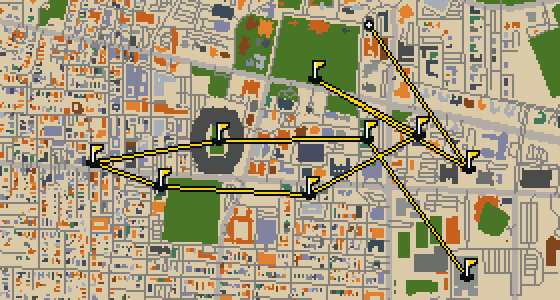
Tuscaloosa is the setting for this round, played on the actual city streets. The map uses real attractions like Bryant-Denny Stadium to build the holes, turning the town into a course. Skip knows these sidewalks well, having spent plenty of time dodging crumbs on the way to the cup. This quick 9-hole round covers 3.2 mi with a total par of 26.

9 HOLES - PAR 26

Reggio Emilia

9 stops

Reggio nell'Emilia is the setting for this round, where the map is the actual city and the ball rolls along its real streets. The holes are built from local attractions, including the Cattedrale di Santa Maria Assunta. Skip knows these blocks well. This quick 9-hole round covers a 5 km walk with a total par of 26.

18 HOLES - PAR 54

Olsztyn

18 stops

Olsztyn is the setting for this round, with a map based on the real city and play taking place on its actual streets. The holes are built from real attractions, ending the walk at the Teren dawnego cmentarza ewangelickiego 1873-1947. This full round of 18 holes covers 10.2 km with a par of 54, using 10 portals to move between districts. Skip is a local guide who knows these pavements well, even the spots where the best crumbs land.

9 HOLES - PAR 24

Le Havre

9 stops

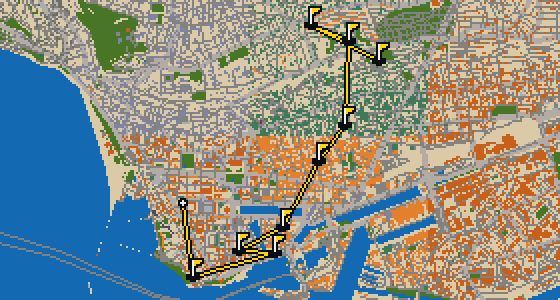
This is Le Havre. The map is the actual city and the round is played on its real streets, using attractions like Église Saint-Joseph as the basis for the holes. Skip is a local guide who knows every corner. It is a quick round of 9 holes with a par of 24, covering a walk of 5.1 km and using 8 portals to move between districts.

9 HOLES - PAR 28

Oceanside

9 stops

Oceanside is the setting for this round, with the ball rolling across the real streets of the city. The holes are built from actual attractions, like the Oceanside Museum of Art. Skip is a local guide who knows every curb and crumb. This quick 9-hole round covers 3.6 mi on foot with a par of 28.

FAQ

Is it free to play?

Yes. Every course runs in the browser with no account and no install.

Do I need to be in the city?

No. The full round plays from anywhere. Walking the real route is a nice way to see the city, but it is not required.

Are the maps real?

Yes. The geometry comes from OpenStreetMap data, rendered chunky on purpose. Streets, water and parks sit where they really are.