
TORONTO - 9 HOLES - FREE

TORONTO
CITY MAP MINIGOLF

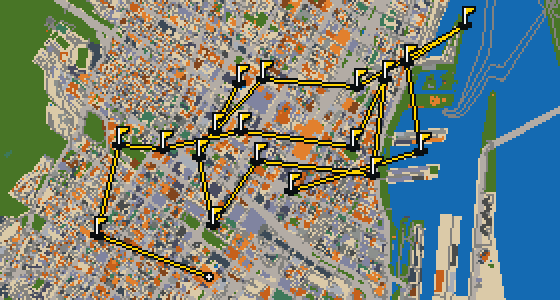
Toronto - 9 stops - par 28

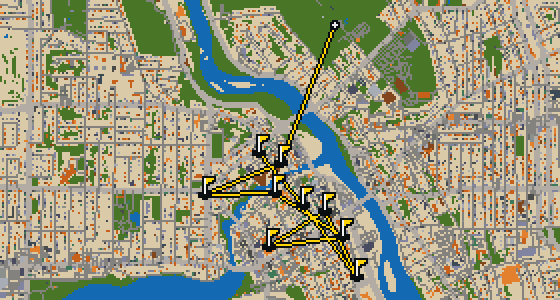
This is a quick nine-hole round through Toronto. The map is the real city and the ball rolls across its actual streets, using attractions like the Royal Ontario Museum as the basis for each hole. Skip is a local guide who knows every crack in the sidewalk. The 5.7 km walk is spread out, using 46 portals to bridge the gaps between landmarks.

Trouble loading? Open the game in its own tab.

HOW IT WORKS

01

Pick a city

The course is drawn on the real street grid, so the map you play is the map you walk.

02

Putt to the pin

Drag to aim, release to swing. Buildings bounce and water costs you a stroke.

03

Sightsee between strokes

Every hole ends at an attraction. Sink the putt, read the story, walk to the next tee.

THE TORONTO ROUND - STOP BY STOP

HOLE 1 - PAR 3

Royal Ontario Museum

The building itself is a massive 74,000-square-metre space. Once you step inside, you will see why the Royal Ontario Museum is the largest museum in Canada. It is a museum of art, world culture and natural history located in Toronto, Ontario. If you are arriving by transit, you can pick out details at the Museum subway station, which was renovated in 2008 to resemble the museum's collection at the platform level. It is a place that brings in more than one million visitors every year. I always find the scale of the place impressive, even for someone who spends most of their time looking at the city from the rooftops.


Wikidata · Wikipedia

HOLE 2 - PAR 3

Bata Shoe Museum

You will first notice the distinct architecture of the Bata Shoe Museum in downtown Toronto. This museum of footwear and calceology is situated near the northwest of the St. George campus of the University of Toronto. Since its inception in 1995, it has provided a dedicated space for the study of shoes. The building itself is a significant point of interest for visitors, spanning 3,665 square metres of space. It was designed by Moriyama & Teshima Architects, with Raymond Moriyama acting as the lead architect. I find that the building's presence in the downtown core makes it a convenient stop for anyone exploring the university area or strolling through the city streets. Whether you are interested in fashion or the science of calceology, there is plenty to see within these walls as you navigate the downtown landscape.

Wikidata · Wikipedia

HOLE 3 - PAR 3

Church of the Redeemer

Located in Toronto, Ontario, Canada, the Church of the Redeemer sits at the intersection of Bloor Street and Avenue Road. You can find this site near the Royal Ontario Museum. The building is an Anglican church designed in the Gothic Revival style. It opened on June 15, 1879. In addition to being a church building, it is used as an event venue. Visitors to this area of the city can observe the specific architectural details of the Gothic Revival style on the exterior of the structure. The location makes it a visible landmark for those traveling through the intersection of Bloor Street and Avenue Road. Whether you are visiting the nearby museum or exploring the neighborhood, this Anglican church is a significant point of interest in the local landscape.

Wikidata · Wikipedia

HOLE 4 - PAR 3

St. Thomas Aquinas Church

St. Thomas Aquinas Church is a church building located in Toronto. It is designed in the Gothic Revival style, which is often identified by its pointed arches and intricate masonry. The building had its inception in 1927, making it a significant piece of the city's architectural history. Arthur W. Holmes was the architect of St. Thomas Aquinas Church, and he utilized the Gothic Revival style to create a space that reflects the traditional aesthetics of the era. For those visiting the area, the church is a point of interest for its structural details and the way it fits into the surrounding urban environment. You can take a moment to observe the facade and the specific way Holmes implemented the Gothic Revival elements to define the presence of the church building within the city.

Wikidata · Wikipedia

HOLE 5 - PAR 3

St. Basil's Church

This is not a cathedral or a downtown parish, but a university church. St. Basil's Church is a university building and the college church of St. Michael's College at the University of Toronto. Designed in the Gothic Revival style, it is a designated heritage property. The project involved the work of three architects: William Hay, Arthur W. Holmes, and Joseph Connolly. Work on the church started in 1856. You can see the influence of these architects in the building's structure, which makes it a notable example of its style within the university setting. It continues to function as a church building while remaining a key piece of the campus architecture for students and visitors to the university.

Wikidata · Wikipedia

HOLE 6 - PAR 4

Justina M. Barnicke Gallery

You can find the Justina M. Barnicke Gallery tucked into Hart House on the University of Toronto's St. George campus. It is a university art museum located in Toronto that was founded in 2014. In that same year, the gallery and the University of Toronto Art Centre federated to form the Art Museum. If you enjoy exploring large collections, this is a great stop for your walk; the Art Museum is the second largest gallery space for visual art and programming in Toronto after the Art Gallery of Ontario. I've noticed it's a peaceful spot to wander when you need a break from the campus crowds, and the atmosphere inside is always welcoming for a visitor. It's a fine place to see how university spaces can blend education with a public art experience.

Wikidata · Wikipedia

HOLE 7 - PAR 3

CAA Theatre

Look up at the facade of 651 Yonge Street to find the CAA Theatre. This theatre building is also a music venue and movie theater that first opened in 1911. It is operated by Mirvish Productions, and you can pick out the transition in the building's history by its previous name, the Panasonic Theatre. Mirvish Productions announced a marketing partnership with CAA South Central Ontario on December 1, 2017. I always find the area around this spot particularly lively for a stroll, though I usually stick to the ledges to get a better view of the crowds. It is a great landmark to aim for when you are navigating the streets of Toronto.

Wikidata · Wikipedia

HOLE 8 - PAR 3

Buddies in Bad Times

You might think this is just another local stage, but Buddies in Bad Times is a professional Canadian theatre company with a specific mission. Based in Toronto, it is dedicated to the promotion of queer theatrical expression. It was founded in 1978 by Sky Gilbert, Jerry Ciccoritti, and Matt Walsh, with its inception occurring in 1979. For those visiting the city, it is a significant cultural landmark that balances its identity as a theatre company, a theatre building, and a gay bar. I've noticed it's a great spot to see how the city embraces diverse voices through the arts. Whether you are a fan of the performing arts or just exploring the neighborhood, this space offers a unique look at the queer community's creative output in a professional setting.

Wikidata · Wikipedia

HOLE 9 - PAR 3

Allan Gardens Conservatory

Six greenhouses make up the heart of the Allan Gardens Conservatory, a botanical garden covering 1,500 square metres. You can wander through these glass structures before stepping out into the wider park. Located in the Garden District of Toronto, Ontario, Canada, this site has been around since it was started in 1858. It is a great spot for a stroll, though you will likely see plenty of activity outside the glass walls too. The property includes a playground and an off-leash dog park, making it a busy hub for the neighborhood. I often see the local dogs getting quite excited near the entrance, which adds a bit of chaos to the greenery.

Wikidata · Wikipedia

STOP 10

CARLU

Look closely at the streamlined shapes and geometric forms of the building; they are classic examples of Art Moderne architecture. This is the Carlu, a national historic site of Canada located in Toronto, Ontario. The space operates as both a restaurant and an auditorium, and it is currently owned by the restaurant firm Oliver & Bonacini. It has a long history in the city, having first opened in 1930. For a long time, the venue was known as Eaton's Seventh Floor before it underwent a process of being restored and reopened in 2003. I've seen a few crumbs dropped near the entrance that make me think the restaurant side of the business is doing quite well.

Wikidata · Wikipedia

OTHER COURSES

9 HOLES - PAR 28

Sherbrooke

9 stops

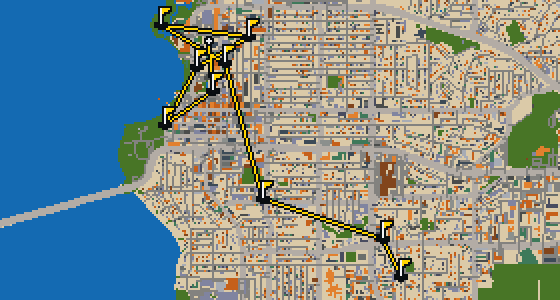
This is Sherbrooke. The map is the real city and the round is played on its real streets, using local attractions like Parc Victoria as the holes. Skip knows these streets by heart. It is a quick 9-hole round with a par of 28, covering a 5.6 km walk that uses 2 portals.

9 HOLES - PAR 27

Kelowna

9 stops

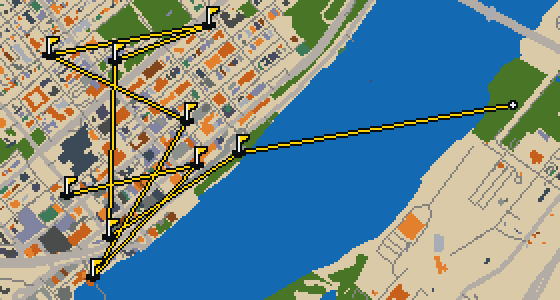
This is Kelowna. The map is the real city and the round is played on its real streets, with the holes built from attractions like the Rotary Centre for the Arts. Skip knows these blocks well. It is a quick round of 9 holes with a par of 27, covering a walk of 5.5 km.

9 HOLES - PAR 30

Regina

9 stops

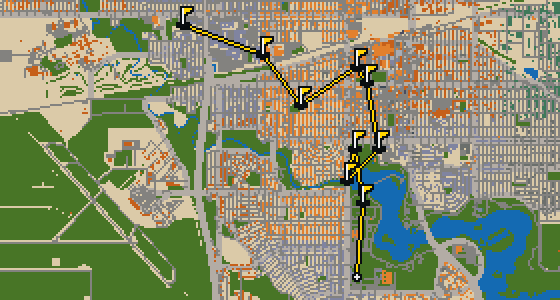
Banking a ball off the stone facades of St. Paul's Cathedral requires a soft touch. This round takes place on the real streets of Regina, where the city map is the course and local attractions form the holes. It is a quick 9-hole round covering 6.5 km, with a couple of portals to speed things along. Skip knows every curb and crack in the pavement here.

9 HOLES - PAR 27

Burnaby

9 stops

This is a quick nine-hole round through Burnaby. The map is the real city and the ball rolls along its actual streets, banking off building facades toward holes built from real attractions like The Columbia. Six portals help bridge the gaps across the 5.3 km walk. Skip is a local guide who knows these sidewalks well, even the crumbs hidden in the corners.

18 HOLES - PAR 57

Longueuil

18 stops

Longueuil is the setting for this round, with the map following the real city and the ball rolling across its actual streets. The holes are built from real attractions, starting at the Centre Bell. Skip knows every crack in the pavement here. It is a full round of 18 holes with a par of 57, covering a walk of 11.4 km. The ball uses 126 portals to bridge the gaps between the landmarks.

FAQ

Is it free to play?

Yes. Every course runs in the browser with no account and no install.

Do I need to be in the city?

No. The full round plays from anywhere. Walking the real route is a nice way to see the city, but it is not required.

Are the maps real?

Yes. The geometry comes from OpenStreetMap data, rendered chunky on purpose. Streets, water and parks sit where they really are.